New SUPREME publication explores ZnO–CeO₂ nanomaterials for sustainable antimicrobial and environmental applications
- 01/10/2026
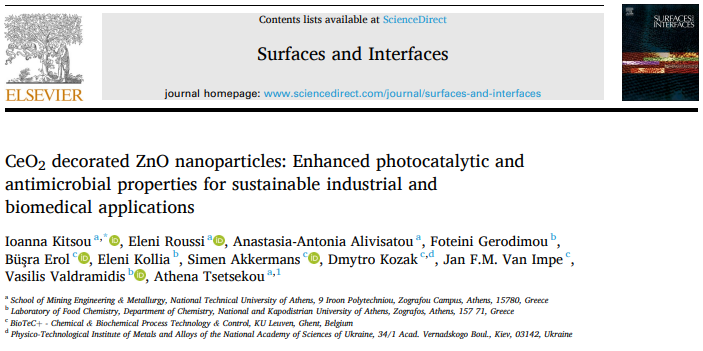
A new scientific publication from the SUPREME project presents important advances in the development of multifunctional nanomaterials with enhanced photocatalytic and antimicrobial properties.
The study, led by researchers from the National Technical University of Athens (NTUA), the National and Kapodistrian University of Athens (NKUA) and KU Leuven (KUL), investigates the design and performance of CeO₂-decorated ZnO nanomaterials developed through a cost-effective co-precipitation method.
The research focused on optimising the composition of ZnO–CeO₂ heterojunctions by varying the CeO₂ content, with the aim of improving their physicochemical characteristics and functional performance. The results showed that the optimised nanocomposite exhibited enhanced photocatalytic activity, achieving 99.4% degradation of methylene blue under direct sunlight and 92.5% degradation under solar simulator conditions within one hour.
Beyond their environmental applications, the developed nanomaterials also demonstrated promising antimicrobial performance. Under light activation, the ZnO–CeO₂ nanocomposites showed antibacterial activity against several pathogenic bacterial strains, including Escherichia coli, Pseudomonas aeruginosa, Klebsiella pneumoniae and Enterobacter cloacae, as well as antifungal activity against Aspergillus niger. These effects are linked to the photocatalytic generation of reactive oxygen species (ROS), which contribute to microbial inactivation.
The findings highlight the potential of ZnO–CeO₂ heterojunctions as high-performance materials for applications ranging from wastewater treatment to antimicrobial coatings, supporting the development of safer and more sustainable solutions based on advanced nanomaterials.
This publication contributes to the scientific objectives of SUPREME – SUstainable nanoPaRticles Enabled antiMicrobial surfacE coatings, which aims to develop efficient, sustainable and multifunctional antimicrobial nanocoatings by combining advances in nanomaterial design, microbiology, safety assessment and industrial validation.
📄 Read the full publication: https://doi.org/10.1016/j.surfin.2026.110780