SUPREME Research on Nanomaterial Safety Presented at EUROTOX 2026 in Vienna
- 15/09/2026
- Vienna, Austria
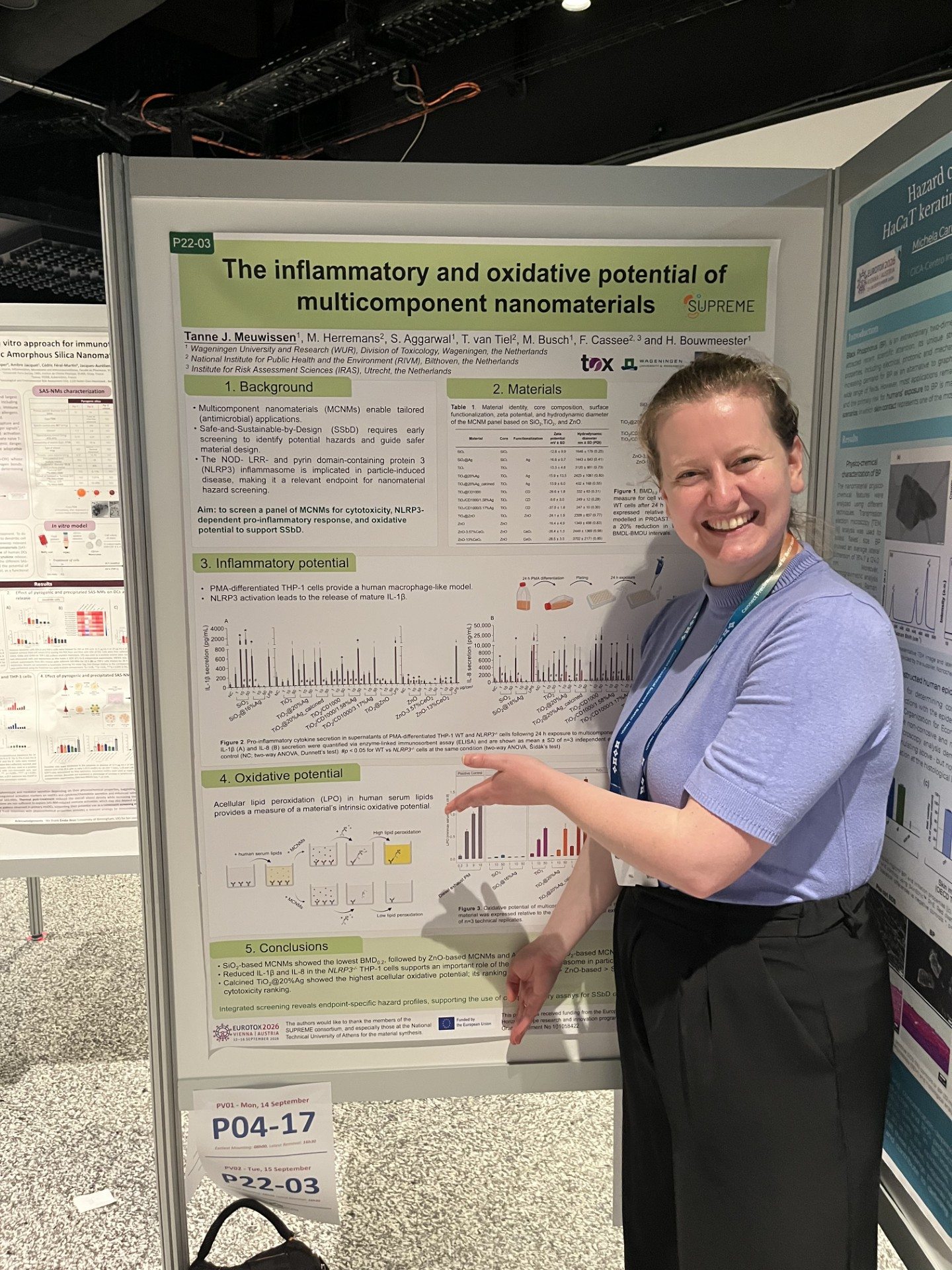
On 15 September 2026, the SUPREME project was represented at EUROTOX 2026 in Vienna, Austria, where Tanne Meuwissen, researcher at Wageningen University & Research (WUR), presented a scientific poster highlighting ongoing research into the potential health hazards of nanomaterials developed within the project.
The poster, entitled “The inflammatory and oxidative potential of multicomponent TiO₂, SiO₂, and ZnO-based nanomaterials: a Safe-by-Design approach”, was presented during the Nanotoxicology session (Poster P22-03), contributing to scientific discussions on the safety assessment of advanced nanomaterials.
Understanding the safety of advanced nanomaterials
Nanomaterials offer significant opportunities for developing innovative antimicrobial coatings with improved functionality and performance. However, ensuring their safety for human health remains essential, particularly as increasingly complex, multicomponent nanomaterials are developed.
Within SUPREME, WUR, in collaboration with the National Institute for Public Health and the Environment (RIVM), is investigating the potential toxicological effects of different nanomaterials to support the project’s Safe-by-Design (SbD) approach.
The research presented at EUROTOX 2026 focused on assessing the inflammatory and oxidative potential of single- and multicomponent nanomaterials based on titanium dioxide (TiO₂), silicon dioxide (SiO₂) and zinc oxide (ZnO).
By examining how these materials interact with biological systems, researchers aim to better understand their potential hazards and generate scientific evidence to guide safer material development.
Investigating inflammatory and oxidative responses
The study explored several biological responses associated with nanomaterial exposure, including oxidative potential, cell viability and the secretion of inflammatory cytokines.
Using laboratory-based cell models, the researchers investigated how different nanomaterial compositions influence these responses, with particular attention to the role of the NLRP3 inflammasome, a component of the immune system involved in inflammatory processes.
The assessment combined multiple biological endpoints to compare the hazard profiles of different nanomaterials and investigate how combining materials may influence their potential toxicity.
This approach contributes to a better understanding of the relationship between nanomaterial composition and biological effects, providing valuable information for future safety assessments.
Supporting SUPREME’s Safe-by-Design approach
The research is directly aligned with one of SUPREME’s core objectives: ensuring that the development of innovative antimicrobial nanocoatings considers potential risks to human health from the earliest stages of material design.
By integrating toxicological assessments into the development process, SUPREME aims to identify potential hazards, inform material selection and support the optimisation of nanocoating formulations without compromising their intended antimicrobial functionality.
The work carried out by WUR and RIVM plays an important role in this process, contributing scientific evidence to guide the development of safer and more sustainable nanocoating solutions.
Sharing SUPREME research with the scientific community
Participation in EUROTOX 2026 provided an opportunity to disseminate SUPREME’s ongoing research within the international toxicology community and contribute to discussions on emerging challenges in nanomaterial safety assessment.
Through activities such as this, SUPREME continues to promote scientific knowledge exchange and strengthen awareness of the importance of integrating safety and sustainability considerations into advanced material development.
Further information:
- Conference: EUROTOX 2026, Vienna, Austria
- Date of presentation: 15 September 2026
- Presenter: Tanne Meuwissen, Wageningen University & Research (WUR)
- Poster: The inflammatory and oxidative potential of multicomponent TiO₂, SiO₂, and ZnO-based nanomaterials: a Safe-by-Design approach
- Session: Nanotoxicology (PV02, P22-03)
- Scientific abstract: https://www.sciencedirect.com/science/article/abs/pii/S0378427426020126